Navigating workplace fashion has become surprisingly complex. As rigid corporate dress codes have given way to flexible, hybrid, and business-casual environments, the clear boundaries that once defined office attire have largely vanished. While this shift offers greater personal comfort, it also introduces ambiguity. Without a strict uniform, it is remarkably easy to drift into clothing that looks either overly casual or disjointed.
Looking professional is not about wearing stiff, uncomfortable garments or clinging to outdated formalities. Rather, it is a visual language of competence, self-respect, and attention to detail. A polished appearance signals that you take yourself, your work, and your colleagues seriously. By focusing on tailoring, resilient textiles, and cohesive silhouettes, you can assemble an office wardrobe that commands respect while feeling entirely effortless.
Prioritize Tailoring Over Price Tags
The single biggest differentiator between an outfit that looks elevated and one that looks sloppy is fit. An inexpensive garment altered by a skilled tailor will almost always look more luxurious than a four-figure designer piece pulled straight off the rack without adjustments. Off-the-rack garments are manufactured to fit broad statistical averages, meaning they rarely flatter an individual frame without targeted alterations.
Focus your alterations on the structural pressure points that frame your body:
-
Shoulder seams: A jacket or blazer must fit your shoulders right away. Tailoring shoulder construction is expensive and rarely yields clean results. Ensure the seam rests squarely at the edge of your shoulder bone without hanging over or pulling across your back.
-
Trouser breaks: Excess fabric pooling around your ankles instantly drags down an entire outfit. Aim for a clean, tailored finish—either a slight break where the trouser hem gently rests on the top of the shoe, or a no-break crop that skims the upper ankle.
-
Sleeve length: Jacket sleeves should end just above the base of your thumb, allowing roughly a quarter-inch to a half-inch of your shirt cuff or watch to show. Excessively long sleeves make blazers look borrowed rather than owned.
Invest in Fabrics with Structure and Longevity
An office outfit must withstand the physical realities of a full workday: commuting, long hours seated at a desk, running between meetings, and moving between varying indoor temperatures. Lightweight, flimsy synthetic knits tend to cling, pill, and wrinkle within hours, leaving you looking disheveled by mid-afternoon.
To maintain a crisp appearance from morning to evening, look for textiles that possess inherent drape and structural integrity.
Choosing High-Performance Natural Fibers
Natural animal and plant fibers, when woven tightly, offer superior breathability and wrinkle recovery.
-
Worsted and tropical wool: Far from being limited to heavy winter suits, four-season wool is naturally elastic and temperature-regulating. It resists wrinkling and holds a sharp trouser crease even after hours at a desk.
-
Heavyweight cotton twill and poplin: For button-downs and casual trousers, select compact, high-thread-count cotton weaves. They offer a clean, opaque finish that looks crisp throughout the day without feeling rigid.
-
Dense ponte and crepe: If you prefer stretch and ease of movement, opt for dense ponte di Roma knits or textured wool-blend crepes. These fabrics offer the flexibility of athletic wear while maintaining enough weight to hold their shape without bagging at the knees or elbows.
Master the Art of Intentional Separates
The monolithic matching suit is no longer mandatory in most offices, but ditching the full suit should not mean abandoning structure altogether. The key to modern office styling is building around intentional separates—mixing tailored elements with relaxed staples to strike a smart, balanced note.
Instead of pairing a standard dress shirt with plain trousers, consider layering a fine-gauge merino wool crewneck under an unstructured blazer. The knitwear softens the severity of the jacket while remaining thoroughly professional.
Similarly, wide-leg pleated trousers paired with a fitted, ribbed knit top and a clean leather belt create an architectural silhouette that feels both contemporary and corporate-ready. The goal is contrast: pair something structured (like a tailored coat or sharp trousers) with something softer (like a fluid silk blouse or fine knit) so the outfit feels dynamic rather than uniform.
Build Around a Cohesive, Low-Contrast Palette
Color plays a decisive psychological role in the workplace. While bold colors and loud patterns have their place, relying on them too heavily can distract from your overall presence and make mixing and matching difficult. A sophisticated office aesthetic relies primarily on a tonal, neutral foundation.
Anchor your rotation with reliable neutrals: navy, charcoal, slate gray, camel, ivory, olive, and rich chocolate brown. These shades work harmoniously together, allowing you to create countless combinations from a compact selection of garments.
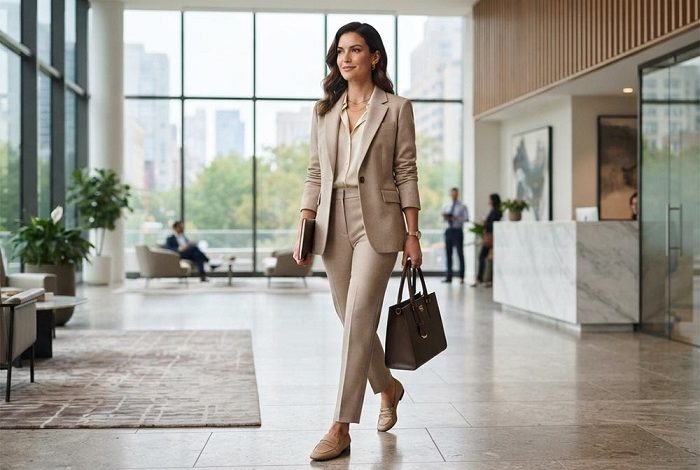
Tonal dressing—wearing varying shades within the same color family—is an effortless styling technique that looks exceptionally high-end. Pairing an oatmeal knit with cream trousers and a camel wool overcoat, or styling a navy blazer over a slate blue shirt and dark indigo denim, creates a long, unbroken vertical line. This monochrome approach looks streamlined, elongates the frame, and eliminates the guesswork of matching disparate shades during busy mornings.
Curate Footwear and Leather Accessories That Signal Authority
Shoes and carry bags are frequently the first items an observer notices, and they carry outsized weight in determining the overall tone of an ensemble. An impeccably tailored outfit paired with scuffed, unmaintained shoes immediately loses its polish.
-
Footwear silhouette: Choose shoes with clean, purposeful lines. Classic leather oxfords, clean double monks, almond-toe loafers, sleek Chelsea boots, and minimalist block-heel pumps project competence. Keep them clean, conditioned, and polished. If your office allows clean sneakers, ensure they are minimalist, unbranded leather models kept free from dirt.
-
Structured carry goods: Soft, floppy bags look messy in a professional setting. A structured leather tote, briefcase, or minimalist folio that can stand upright on a conference table or desk instantly elevates your presence.
-
Hardware alignment: Keep your hardware unified. Match the metal tone of your watch, belt buckle, shoe hardware, and bag accents. Cool silvers and chrome complement gray and navy; warm brass and gold pair naturally with earth tones, browns, and warm ivories.
Practice Editorial Restraint
When putting the finishing touches on your office look, adopt an editor’s eye. The most polished professionals never look overloaded with accessories. A discreet timepiece, modest earrings, a subtle signet ring, or a neat leather belt should complement your outfit, not compete for attention.
True polish in the modern workplace comes from restraint, deliberate proportion, and fabric quality. When your clothes fit cleanly, move with you comfortably, and reflect intentional choices, your wardrobe ceases to be a daily stressor and becomes a dependable extension of your professional authority.